.png?width=175&height=73&name=ORIGINAL%20LOGO%20Blue%20and%20Green%20(1).png "PathIvy Logo")
.png?width=50&name=author-image%20(2).png)

More than 1,400 accredited colleges and universities adopted test-optional policies by fall 2022, representing over 60% of undergraduate institutions nationwide, according to FairTest.
This shift includes all public four-year universities in Washington, which have moved to permanent test-optional policies.
For students, this marks a major change in how applications are evaluated.
Test-optional does not mean tests do not matter.
It means:
- you can choose whether to submit SAT or ACT scores
- colleges will evaluate your application holistically
- other parts of your application carry more weight
As a result, admissions decisions rely more heavily on:
- academic performance
- course rigor
- extracurricular involvement
- personal context
This broader evaluation process is part of what’s known as holistic admissions, where schools assess the full picture of a student rather than just metrics, as explained in How Selective Colleges Evaluate Applicants Holistically.
Admission Data: Washington Universities
The impact of test-optional policies is already clear.
At the University of Washington:
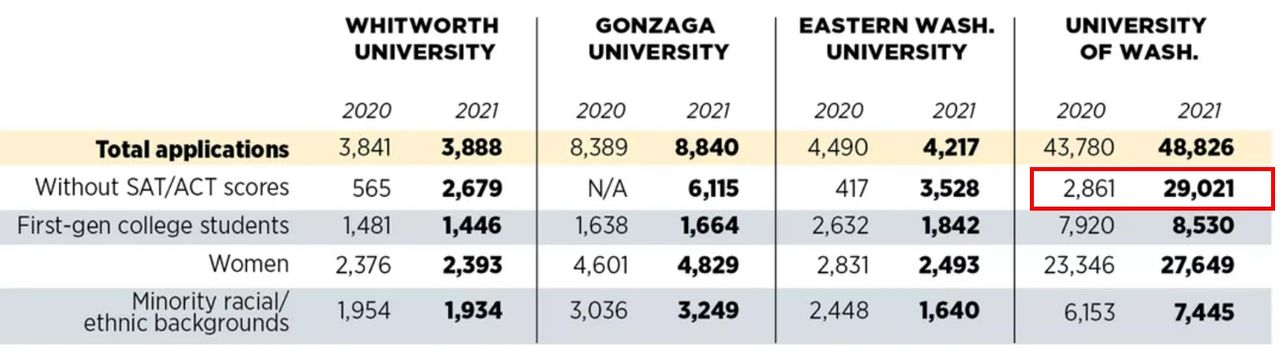
- 29,021 applications were submitted without SAT/ACT scores in 2021
- compared to just 2,861 in 2020
- nearly a 10x increase
This reflects a major shift in applicant behavior.
At Eastern Washington University:
- 83.7% of applicants applied without test scores
- up from just 9.3% the previous year
At Gonzaga University:
- ~69.2% of freshman applications were submitted without test scores
Why Applications Are Becoming More Holistic
With fewer students submitting standardized tests, colleges are placing greater emphasis on other factors.
This includes:
- GPA and academic consistency
- course rigor
- extracurricular involvement
- personal background and context
Students can no longer rely on test scores to differentiate themselves.
Instead, the strength of their overall profile becomes the deciding factor.
Understanding what qualifies as a strong academic record is especially important in this environment, particularly when evaluating performance benchmarks like those outlined in What Is a Good GPA for College Admissions?.
What This Means for Applicants
1. Grades Matter More Than Ever
Your transcript is now one of the most important parts of your application.
2. Activities Need Depth
Admissions officers look for:
- sustained involvement
- leadership
- meaningful contribution
Simply listing activities is not enough.
Students should focus on building impactful experiences over time, especially since strong extracurriculars now play a larger role in distinguishing applicants, similar to what’s discussed in How Many Extracurriculars Do Top Colleges Really Expect.
3. Your Application Must Tell a Clear Story
Without test scores, clarity becomes critical.
Your:
- academic choices
- activities
- interests
should all connect.
4. More Students Are Applying
Test-optional policies lower barriers, which leads to:
- larger applicant pools
- increased competition
This trend has been seen nationally, particularly at large public universities.
Final Thoughts
Test-optional policies have reshaped college admissions.
They have made applications:
- more accessible
- more competitive
- more holistic
For students, this means success is no longer about one score.
It is about:
- consistency
- depth
- alignment
Students who understand this shift and build their profile intentionally are the ones who stand out.
How PathIvy Helps Students Navigate Test-Optional Admissions
At PathIvy, we help students:
- build strong academic foundations
- develop meaningful extracurricular profiles
- position their applications strategically
- understand when and whether to submit test scores
Test-optional does not make admissions easier. It makes strategy more important.