.png?width=175&height=73&name=ORIGINAL%20LOGO%20Blue%20and%20Green%20(1).png "PathIvy Logo")
.png?width=50&name=author-image%20(2).png)


For high school students interested in medicine, healthcare, public health, or biomedical science, joining a pre-med club is only one way to explore the field.
Healthcare competitions give students a more structured way to test those interests.
Depending on the competition, students may analyze clinical cases, demonstrate medical terminology knowledge, develop public health interventions, practice healthcare skills, or propose solutions to real-world health problems.
For students eventually targeting selective pre-med pathways, BS/MD programs, public health programs, or healthcare-related majors, these experiences can also provide something valuable for college admissions: evidence that an interest in healthcare has developed beyond the classroom.
Here are some of the healthcare competitions high school students should know about.
1. HOSA – Future Health Professionals
HOSA is one of the most established options for high school students interested specifically in healthcare careers.
Through HOSA's Competitive Events Program, students can participate in events across multiple categories, including health science, health professions, emergency preparedness, leadership, teamwork, and recognition events.
Depending on the event, students might work with medical terminology, epidemiology, biomedical laboratory science, clinical nursing, public health, or other areas of healthcare.
That breadth is particularly useful for students who know they're interested in healthcare but haven't decided whether that means becoming a physician, working in public health, pursuing biomedical research, or entering another health profession.
For college admissions, simply writing "HOSA member" isn't particularly differentiated. Progression matters much more.
A student who competes over several years, specializes in an event, advances through competition levels, or eventually takes on chapter leadership can demonstrate much greater depth than someone who joins during junior year and attends a few meetings.
2. HOSA Biomedical Laboratory Science
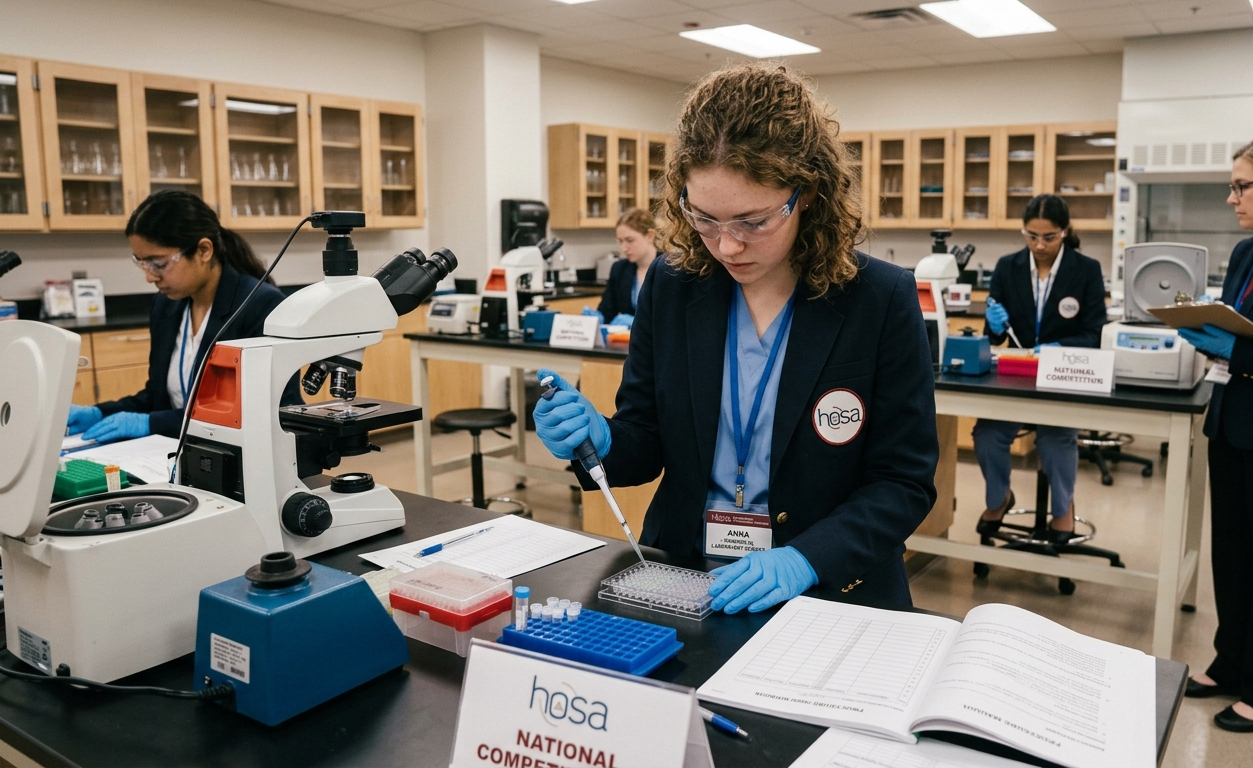
Students interested in the laboratory and diagnostic side of healthcare can explore HOSA's Biomedical Laboratory Science competition.
This is particularly relevant for students considering medicine, pathology, biomedical science, clinical laboratory science, or related fields.
Rather than approaching "pre-med" as a generic interest, a laboratory-focused competition can help students develop more specific exposure to the scientific processes underlying diagnosis and patient care.
That specificity matters.
Selective colleges see many students who say they want to become doctors. Far fewer applications clearly demonstrate what part of medicine or healthcare actually interests the student and how they explored it.
3. HOSA Medical Terminology
Medical Terminology is another healthcare-focused HOSA event and can provide an accessible entry point for students beginning to explore the field.
Students develop familiarity with terminology involving human anatomy, physiology, diseases, procedures, and healthcare.
By itself, a terminology competition probably shouldn't become the centerpiece of a highly competitive pre-med application.
But it can become an early step in a longer trajectory.
For example:
Medical Terminology → advanced biology/anatomy coursework → hospital volunteering → health research → deeper healthcare specialization
That progression tells a much stronger story than a collection of unrelated medical activities.
4. HOSA Epidemiology
For students interested in the intersection of medicine, statistics, disease, and population health, epidemiology can be an especially useful direction.
This type of competition can expose students to questions beyond individual patient treatment:
How do diseases spread?
How do researchers identify risk factors?
How does data inform public health interventions?
How should communities respond to outbreaks?
Students interested in public health, epidemiology, biostatistics, global health, or health policy may find this direction more aligned with their interests than traditional "pre-med" activities.
It can also help a student develop a more specialized academic profile.
Instead of simply presenting themselves as someone who "likes biology and wants to help people," they may begin demonstrating a sustained interest in population-level healthcare problems and quantitative health analysis.
5. HOSA Public Health
Healthcare isn't limited to clinical medicine.
HOSA's Public Health event gives students another route into health-related competition by focusing on public health education and communication.
That can be especially valuable for students interested in areas such as:
- Preventive medicine
- Community health
- Health education
- Global health
- Health disparities
- Public policy
Students who enjoy both science and communication may find public health particularly compelling because it requires translating technical healthcare information into something communities can actually understand and use.
This can also create opportunities beyond the competition itself.
A student might take an issue they encountered through competition and later develop a school campaign, educational resource, community initiative, or independent project around it.
That's when an activity begins turning into a broader area of intellectual and extracurricular depth.
6. HOSA Clinical and Emergency-Care Events
Students interested in more applied healthcare experiences can also explore HOSA events related to clinical and emergency-care skills.
These competitions can introduce students to procedural thinking, patient-care scenarios, emergency response, and healthcare-specific technical knowledge.
For students considering nursing, emergency medicine, allied health professions, or other clinical careers, these events can provide a different type of exploration from traditional science competitions.
The key is choosing events because they genuinely align with the student's interests—not because one sounds more impressive on a college application.
Are Healthcare Competitions Good for College Admissions?
They can be.
But the name of the competition is rarely the most important part.
Admissions officers are more likely to care about what the student actually did with the opportunity.
Consider the difference between:
Student A: Joined HOSA junior year and participated in one competition.
Student B: Joined as a freshman, explored multiple healthcare disciplines, specialized in epidemiology, advanced competitively, became a chapter leader, and later developed an independent public health project.
Both students participated in HOSA.
Their extracurricular trajectories are completely different.
Healthcare competitions become more valuable when they demonstrate:
Progression. The student's involvement becomes more advanced over time.
Achievement. The student performs well or advances competitively.
Specialization. The student develops a specific healthcare interest.
Leadership. The student begins helping organize, teach, mentor, or lead.
Application. The student takes what they learned beyond the competition.
That's similar to how colleges evaluate academic competitions more broadly: participation is a starting point, not necessarily the differentiator.
Healthcare Competitions vs. Research or Internships
Students don't necessarily need to choose only one.
These experiences serve different purposes.
A healthcare competition can provide structured skill development and measurable achievement.
Research can expose students to scientific methodology and unanswered questions.
An internship can provide professional or clinical exposure.
The strongest choice depends on the student's interests and existing profile.
For example, a student interested in epidemiology might compete through HOSA, learn statistical programming, conduct public health research, and eventually pursue an internship with a health-focused organization.
Those experiences reinforce one another.
A student interested in healthcare should therefore avoid asking, "Which activity looks best?"
A better question is:
"Which experience helps me investigate my specific interest more deeply?"
Our guide to internships vs. research vs. summer programs explains how these different opportunities can fit into a larger admissions strategy.
Do You Need to Win a Healthcare Competition?
No.
Winning at the state, national, or international level can certainly provide a meaningful distinction, but competition results are only one part of an extracurricular profile.
A student can still build significant depth without becoming a national champion.
What matters is what develops from the experience.
Maybe competing in epidemiology leads to an interest in biostatistics.
Maybe a public health event leads to a community health initiative.
Maybe biomedical laboratory science leads to research.
Maybe an emergency-care event helps a student realize that they're more interested in nursing or emergency medicine than the physician pathway they originally imagined.
That intellectual development can ultimately become more meaningful than the award itself.
The Bottom Line
Healthcare competitions can be excellent opportunities for high school students interested in medicine, public health, biomedical science, and other health professions.
But students shouldn't participate simply to add "pre-med" credentials to an application.
The strongest healthcare profiles show increasing technical knowledge, specialization, sustained involvement, and real-world application.
Start with exploration.
Find the healthcare problems or disciplines that genuinely hold your attention.
Then go deeper.
Want to Learn Which Healthcare Competitions Are Worth Pursuing?
PathIvy is hosting a Healthcare, Biology & Chemistry Competitions webinar on Sunday, September 20, 2026 from 4–5 PM PT for students and families who want to better understand the competition landscape.
We'll break down opportunities students can pursue, how different competitions fit different academic interests, and how competitions can become part of a stronger long-term extracurricular strategy.
For students considering medicine, healthcare, biology, chemistry, or related majors, it's an opportunity to move beyond simply joining another club and start identifying experiences that actually build depth.
Frequently Asked Questions
What are the best healthcare competitions for high school students?
Some of the best healthcare-related competitions for high school students include HOSA-Future Health Professionals, the BioGENEius Challenge, Regeneron Science Talent Search, Regeneron International Science and Engineering Fair (ISEF), the USA Biology Olympiad (USABO), and neuroscience and biomedical research competitions. The best choice depends on a student's interests, grade level, eligibility, and academic goals.
Are healthcare competitions good for college admissions?
Yes. Healthcare competitions can strengthen a college application when they demonstrate genuine interest, academic depth, problem-solving, research, leadership, or commitment to healthcare and science. Participation is most valuable when it fits into a student's broader academic and extracurricular interests.
What healthcare competitions can high school students participate in?
High school students can participate in competitions focused on medicine, biology, biotechnology, neuroscience, public health, research, and healthcare innovation. Options may include HOSA, BioGENEius, USABO, ISEF, Regeneron STS, and other science and health-related competitions.
Can freshmen and sophomores participate in healthcare competitions?
Yes. Many healthcare and science competitions offer opportunities for students in different high school grades. Students should review the eligibility requirements for each competition because age, grade level, location, and prerequisite requirements can vary.
Do I need to win a healthcare competition for it to help my college application?
No. Winning a competition can be a significant achievement, but participation can still be valuable when it reflects sustained interest, intellectual curiosity, skill development, and meaningful engagement. Colleges generally consider the depth and context of an activity rather than simply counting awards.
Are healthcare competitions useful for students interested in pre-med?
Yes. Healthcare competitions can help students explore medicine, biology, neuroscience, biotechnology, public health, and related fields. They can also complement research, volunteering, clinical exposure, and other meaningful healthcare-related experiences.
How can I choose the right healthcare competition for high school?
Choose a competition based on your academic interests, grade level, eligibility, experience, time commitment, competition format, and long-term goals. Students interested in research may prefer research-based competitions, while students who enjoy exams, teamwork, leadership, or healthcare knowledge may prefer other formats.
How can healthcare competitions help students stand out in college admissions?
Healthcare competitions can help students demonstrate intellectual curiosity, scientific knowledge, initiative, persistence, leadership, and a sustained interest in healthcare. Their impact is strongest when students pursue meaningful depth rather than participating in competitions solely to add another activity to their résumé.