.png?width=175&height=73&name=ORIGINAL%20LOGO%20Blue%20and%20Green%20(1).png "PathIvy Logo")
.png?width=50&name=author-image%20(2).png)


When it comes to Ivy League admissions, Cornell University stands out for its diverse academic programs, vibrant campus life, and highly selective admissions process. If you’re aiming for Cornell, understanding GPA expectations is a critical first step.
Your GPA, test scores, extracurriculars, and essays all play a role in admissions, but GPA often forms the foundation of a strong application.
Why GPA Matters for Cornell Admissions
Cornell receives tens of thousands of applications each year from highly accomplished students. GPA gives admissions officers a clear view of:
- academic consistency
- work ethic
- readiness for rigorous coursework
Unlike standardized tests, GPA reflects long-term performance. Cornell also evaluates how you challenge yourself through AP, IB, or honors coursework.
Admissions is holistic, meaning GPA is just one piece of the puzzle. To better understand how schools evaluate applicants beyond numbers, it helps to review How Selective Colleges Evaluate Applicants Holistically.
The Average GPA for Cornell University
The average admitted student GPA is approximately:
- 4.0+ weighted
- 3.9+ unweighted
Most admitted students:
- earn mostly A’s
- take advanced coursework
- rank near the top of their class
However, GPA is evaluated alongside:
- course rigor
- grade trends
- school context
Understanding how your GPA compares to top schools is important, especially when benchmarking against Ivy expectations using tools like the GPA Calculator for High School Students.
Cornell Acceptance Rate and Competitiveness
Cornell remains highly selective:
- Acceptance rate: ~7–8%
- Applications: 70,000+
- Admitted students: ~5,500
This means fewer than 1 in 10 applicants are admitted.
At this level, GPA helps establish competitiveness, but it is not enough on its own. Understanding how acceptance rates fit into admissions strategy can provide useful context, especially in Acceptance Rate vs Yield Rate: What Matters for Ivy League Colleges?.
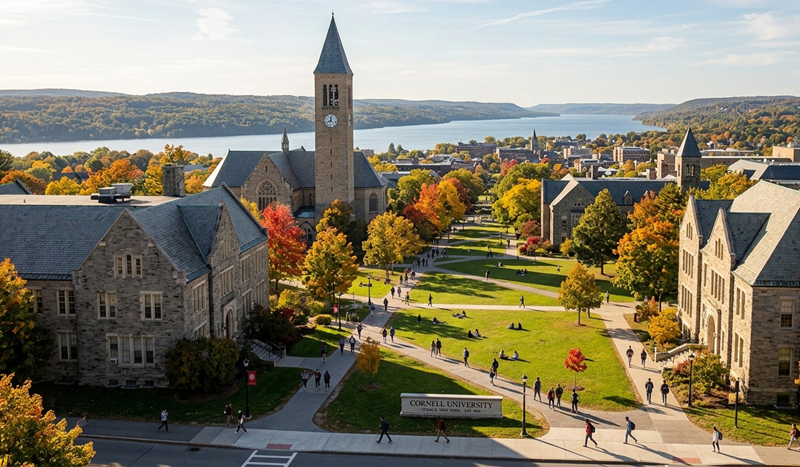
GPA Expectations by Cornell Colleges
Cornell’s undergraduate colleges vary slightly in selectivity.
Typical GPA ranges:
- Engineering: 4.0–4.3+
- Arts & Sciences: 3.9–4.2+
- Human Ecology / CALS: 3.8–4.1
- Hotel School / AAP: 3.7–4.0
More technical or competitive programs tend to expect higher GPAs.
Students applying to STEM-heavy majors should understand how major choice impacts admissions, especially in How Competitive Majors Affect Admissions Chances.
What If Your GPA Is Below Cornell’s Average?
A lower GPA does not automatically disqualify you.
Cornell also considers:
- strong test scores
- compelling essays
- leadership and impact
- recommendation letters
Students with strong narratives and upward trends can still stand out. This is why application positioning matters just as much as raw numbers, especially when building a cohesive story as outlined in How to Write an Authentic College Essay That Stands Out
How to Improve Your GPA Before Applying
If you are still in high school, you can strengthen your GPA by:
- improving consistency across semesters
- seeking help early
- balancing rigor with performance
- showing upward grade trends
Admissions officers value growth and resilience.
How GPA Fits into Cornell’s Holistic Review
Cornell does not have a strict GPA cutoff.
Instead, they evaluate:
- academic performance
- intellectual curiosity
- personal context
- contributions to the community
Your GPA is important, but it works alongside every other part of your application.
Final Thoughts
A strong GPA ideally 3.9+ unweighted or 4.0+ weighted will significantly strengthen your Cornell application. However, GPA alone is not enough.
Successful applicants combine:
- academic excellence
- clear direction
- meaningful experiences
- strong storytelling
Use tools like a GPA calculator to stay on track, but focus on building a well-rounded, thoughtful application.
Frequently Asked Questions
What GPA do you need to get into Cornell University?
Cornell does not have a strict minimum GPA requirement. Most admitted students have very strong academic records, with the article noting typical admitted student GPAs of approximately 3.9+ unweighted and 4.0+ weighted. Cornell evaluates GPA in the context of course rigor, grade trends, and the student's school.
Is a 3.8 GPA competitive for Cornell?
A 3.8 GPA can be competitive for Cornell, particularly when supported by rigorous coursework, strong grades in challenging classes, meaningful extracurricular activities, strong essays, and other compelling parts of the application. Cornell evaluates applicants holistically rather than using GPA alone.
Does Cornell University have a minimum GPA requirement?
Cornell does not have a published strict GPA cutoff for undergraduate admission. Academic performance is considered along with course rigor, grade trends, school context, extracurricular activities, essays, recommendations, and other application factors.
Does Cornell consider weighted or unweighted GPA?
Cornell evaluates a student's academic performance in context rather than relying only on a single GPA calculation. Both weighted and unweighted GPA information can provide useful context, along with the rigor of the student's coursework and the grading system used by the high school.
What GPA is expected for Cornell Engineering?
The article identifies a typical GPA range of approximately 4.0–4.3+ for Cornell Engineering applicants. However, Cornell does not use a simple GPA cutoff, and applicants are evaluated based on their complete academic profile, including course rigor, grades, and other application factors.
What GPA is expected for Cornell Arts and Sciences?
The article identifies a typical GPA range of approximately 3.9–4.2+ for Cornell Arts and Sciences applicants. These figures should be viewed as general benchmarks rather than official Cornell GPA requirements.
Can you get into Cornell with a GPA below 3.9?
Yes. A GPA below 3.9 does not automatically disqualify an applicant. Cornell uses holistic admissions and also considers factors such as course rigor, grade trends, test scores when submitted, essays, leadership, extracurricular impact, recommendations, and personal context.
Does Cornell care about AP, IB, and honors courses?
Yes. Cornell considers the rigor of a student's coursework when evaluating academic preparation. Taking challenging AP, IB, honors, or other advanced courses can demonstrate readiness for rigorous college-level study, especially when the student performs well in those courses.
Does Cornell consider upward GPA trends?
Yes. Grade trends are part of the academic context considered in the application. An upward trend can help demonstrate academic growth and improvement, particularly when accompanied by challenging coursework and strong performance in later years.
How can I improve my GPA before applying to Cornell?
Students can work on improving their GPA by maintaining consistent performance across semesters, seeking academic help early, balancing course rigor with strong grades, and demonstrating an upward academic trend. Students should focus on sustainable academic improvement rather than taking courses solely to increase a numerical GPA.
How PathIvy Helps You Build a Competitive Cornell Application
At PathIvy, we help students:
- track and improve academic performance
- build strong application strategies
- align GPA with extracurriculars and essays
- position themselves effectively for selective schools
Your GPA is the foundation, but your strategy determines the outcome.